Icons: Anna Wintour
Anna Wintour was born on July 21st, 1954 in London, England. She attended St Paul’s Girls School and then went on to study English Literature at Newnham College, Cambridge University. After graduating she worked for British Vogue magazine before becoming the editor-in-chief of American Vogue magazine in 1992.
Anna Wintour is known for being very stylish wearing classic clothing with a modern twist. She also loves wearing accessories such as hats, scarves, and those infamous dark sunglasses. We take a look back over the years of the most influential woman in Fashion.
Read – The Glamorous Met Gala 2022, Everything you need to know
Dame Anna Wintour (DBE) has served and influenced fashion for decades as the editor in Chief of Vogue since 1988 and is now its Global Editorial Director. She is also currently the Global chief Content Officer for Conde Nast and the Artistic Director of Condé Nast and she has no plans to retire.
Her recent pictures with Queen Elizabeth II seem apt somehow. Two women that have devoted their lives in service to something bigger than themselves. Indeed, the Queen appointed Wintour Officer of the Order of the British Empire (OBE) in the 2008 Birthday honours and in 2017 she was made a Dame.
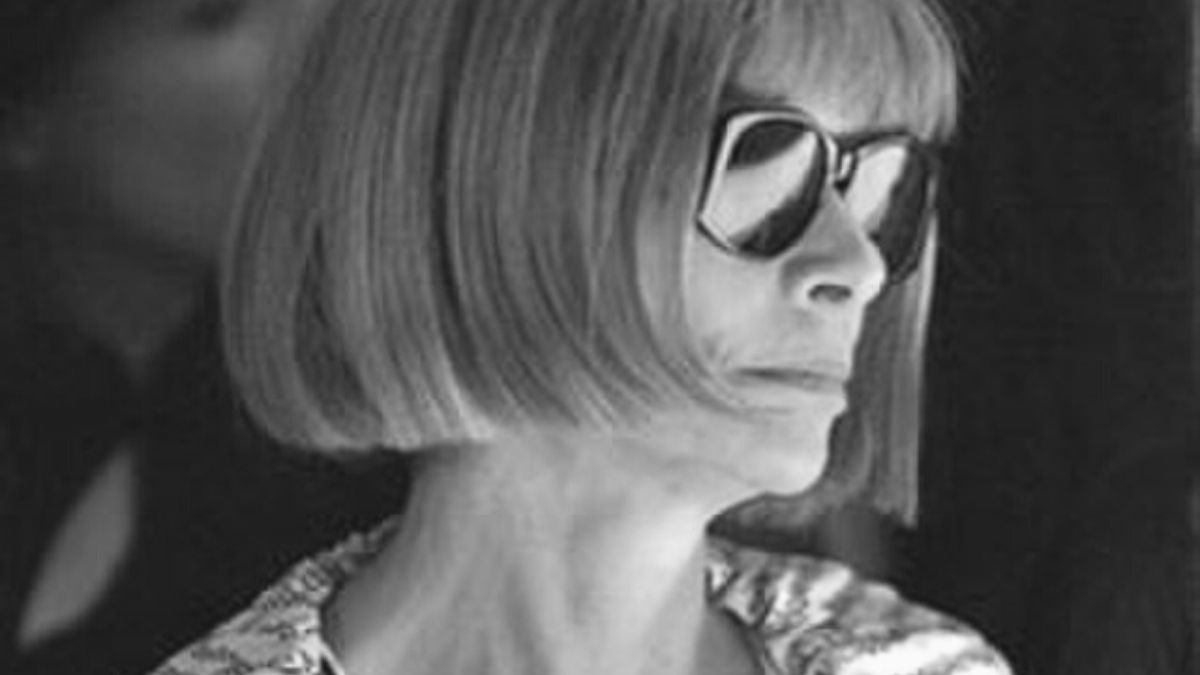
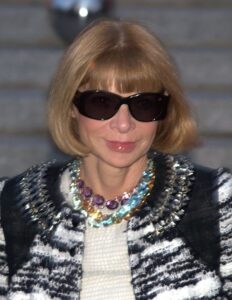
The British American Journalist has become iconic for so many reasons. Her trade mark bob hair cut none the least – a style she has sported since 14 years old. Her dark sunglasses enhance her aloof, glacial character, she is infamously never seen without them. People who meet her often talk of admiration which belies a sense of fear. But it is Wintour’s influence on the Fashion industry that has elevated her to iconic status.
Known for her workaholic lifestyle, her reputation precedes her. Anna’s demanding personality has earned her the nickname ‘Nuclear Wintour’. In 2006, a previous assistant- Lauren Weisberger- wrote a book about her experiences at Vogue working with her and later in the film, The Devil Wears Prada was a box office hit. In it, the Editor in Chief is a ruthless, if not rude character with a no-nonsense style of management.
Weisberger has never admitted that the character is that of Wintour, who actually attended the premier claiming to have enjoyed the film. Although recently, Wintour hit the headlines claiming she couldn’t remember who wrote the book. But then she always did know how to court publicity.
Read – 10 Exciting Fashionable Films You Need to Watch Right Now
Born in Hampstead London in 1949, her father was Charles Wintour, Editor at the London Evening Standard. He often involved Anna in decisions on how to make the newspaper more relevant to a younger audience. Her stepmother, Audrey Slaughter was also a magazine editor and founded publications such as Honey and Petticoat. Journalism definitely runs in the family, one of her younger brothers, Patrick Wintour is also a journalist at the Guardian.
Anna’s first job was at the iconic Biba boutique at just 15 and she was also part of a Harrods training program. She dated several older men in her younger years and Australian writer, Richard Nevill, gave her her first experience of a magazine production called OZ.
In 1970 Wintour worked at Harper’s and Queen as the first editorial assistant giving her all essential fashion journalism skills. Some would say that she came from a privileged background with connections and this helped to secure her advance into the world of journalism. She dated several writers and certainly, this must have been of benefit. She was able to secure locations for creative shoots by Helmut Newton and Jim Lee in those initial years. The visual ideas were all down to her, and her creative vision set her apart.
She was driven and temperamentally determined. She moved to New York with her boyfriend, Jon Bradshaw who was a freelance journalist in the early 1970s. Taking risks was not something she has ever feared.
In 1975 she was a junior editor at Harper’s Bazaar in New York City, a position she was fired from in under a year. But ever determined and with those good connections, she got her first position as fashion editor at Viva – a women’s adult magazine. It was not Vogue, but it laid the foundation of her career in editorialising.
After a break-up with her boyfriend Bradshaw, she began dating French record producer Michel Esteban and became a fashion editor at Savvy. This publication sought to appeal to career-conscious professional women who were financially independent. This was the audience Anna Wintour was after and her career at Vogue has largely targeted this audience.
Wintour soon learned a year later as editor of New York, that the power of the cover photo and how celebrities gracing the fronts of magazines brought in the cash- this has been her signature skill, putting her in the history books of fashion fame.
“Anna saw the celebrity thing coming before every else did’
Grace Coddington
In 1983 she got her first position at Vogue for a handsome salary and became the magazine’s first Creative Director by 1985 she was editor of British Vogue. Her first move was to replace many of the staff and assume full control, a pattern of behaviour that was to be repeated wherever she went.
She aligned British Vogue with that of the US and targeted the magazine to the same demographic. Commenting on the reader, she made it clear who she was after.
“She’s interested in business and money. She doesn’t have time to shop anymore. She wants to know what and why and where and how.”Anna Wintour on Vogue reader Demographics
By 1988 Wintour was editor of US Vogue and it was then that her penchant for rule-breaking put her in the hall of fashion fame.

Her front covers would take place in outdoor venues and more of the body was shown. She used less well-known models and created impactful styling using high street and designer clothes- something that was groundbreaking at the time. Michaela Bercu is featured on the cover with high street jeans coupled with a 10,000-dollar Jacket from Lacroix. Not only had jeans never been featured on the cover, but Michaela also wasn’t even looking at the camera and her hair was blowing all over in the street – a candid casual shot. The printers called to ask if it was a mistake.
Wintour later called this ‘a leap of faith’ – this was indeed the way real women put clothes together. The cover later showed models with wet hair, no make up and in bathrobes – again something that caused outrage at the time.
Her career was only on the up and throughout the 1990s Vogue held its position against the market competition of Harpers Bazaar and Elle. In the 2000s despite a large turnover of the editorial staff, the 2004 September issue was 832 pages only to be exceeded in 2007. Wintour also expanded the brand by creating Teen Vogue, Vogue Living and Men’s Vogue.
However, not all of these spinoffs survived the long haul like Vogue itself. Indeed, she is not without controversy and criticism. In 2008 Wintour was criticised for racial stereotyping.
LeBron James and Gisele Bündchen brought criticism for their evocation of racial stereotypes of a black man wanting to be with a white woman. More recently, amidst the Black Lives Matter campaign, she has spoken out and apologised for Vogue’s lack of initiative on racial matters.
I want to say plainly that I know Vogue has not found enough ways to elevate and give space to Black editors, writers, photographers, designers and other creators. We have made mistakes, too, publishing images or stories that have been hurtful or intolerant. I take full responsibility for those mistakes.
Anna Wintour
Her persistent use of fur in her campaigns has also courted much controversy and she has umbilically spoken about several attacks from animal rights activists.
Some would argue that Wintour has too much control. Her elitism has allowed her to select prominent socialites and dress them in loaned clothes from designers of her choice which is rather undemocratic. Wintour’s control and influence on the fashion world cannot be denied, she has saved, destroyed and anointed designers at will.
“The end result is that Anna can control it all the way to the selling floor“, says Candy Pratts Price, executive fashion brand consultant.
Several books about her life have been written. Jerry Oppenheimer’s book, Front Row, depicts her as a feminist. Growing up in the 60s was definitely an exciting era for fashion, and Wintour was very aware of the rise of women’s liberation and its aesthetic.
Read – The Incredible André Leon Talley 1948 – 2022
Her changes at Vogue have reflected, reinforced and acknowledged women’s advances in society. Yes, the magazine sells ads, but under Wintour, has always reminded women to take pride and satisfaction, parading in all manner of fineries of clothing that successful women might acquire or inspire to buy.
Rather than play to the insecurities of the reader, Wintour’s vogue exploits ambition – celebrities and politicians have all graced the cover and they have done so not just for how they look but for what they have accomplished, and Wintour sees nothing wrong with that.
There was a sense that women who were interested in and love fashion might not be substantial, which is of course a ridiculous thought. I think, actually, being proud of how you look and how you present yourself is very empowering in itself. Just because you love fashion and follow it doesn’t mean that you can’t care about the issues of the day
Anna Wintour
By Vicky Hatia