![Low-Impact Fitness Routine [Adobe]](https://www.chicstylecollective.com/wp-content/uploads/2026/01/Chic-Style-Collective-Hero-Image-1207-960x650.jpg "Chic Style Collective | The Low Impact Fitness Routine Busy Women Actually Stick To")
Low Impact Fitness Routine
Most busy women don’t struggle with motivation; they struggle with feasibility. The glossy fitness trends that dominate social media tend to assume unlimited time, unlimited energy, and unlimited hamstrings. In reality, the modern woman’s day is a sequence of compressed windows: school runs, meetings, commuting, inboxes, childcare, social obligations, and home life. Choosing a workout style that bends around life rather than demanding life bends around it—is the true marker of sustainability.
In 2026, that sustainable model is low-impact fitness. From Pilates to barre to strength-based mat work, low-impact routines are gaining momentum not because they are new or flashy, but because they integrate seamlessly into daily structure. They’re also aligned with a broader lifestyle shift: elevated, longevity-driven wellness that supports energy, posture, mental clarity, and mobility instead of chasing extremes. It is fitness as refinement rather than punishment, which is perhaps why it resonates so strongly with the quiet-luxury woman.
Low impact fitness also carries the same values that underpin modern quiet luxury—quality over excess, consistency over chaos, longevity over quick wins. The same way a Toteme blazer becomes a wardrobe staple because it quietly elevates everything around it, the right low-impact routine elevates one’s health without demanding identity-level upheaval.
Why Low-Impact Works in Real Life
Low-impact workouts are physiologically efficient. They strengthen stabilising muscles, support bone density, improve posture, and increase flexibility—all without the cortisol spikes, injury risk, or recovery lag associated with high-impact extremes. They’re accessible to different ages, fitness levels, and phases of life, which is why you’ll see 22-year-olds and 52-year-olds in the same reformer studio without anyone feeling out of place.
There is also a psychological dimension. High-intensity fitness often relies on hyped adrenaline and a “push harder” mentality. Low impact fitness routines are calmer, quieter, and confidence-building. They appeal to women who want to feel strong, elegant, and capable—not exhausted.
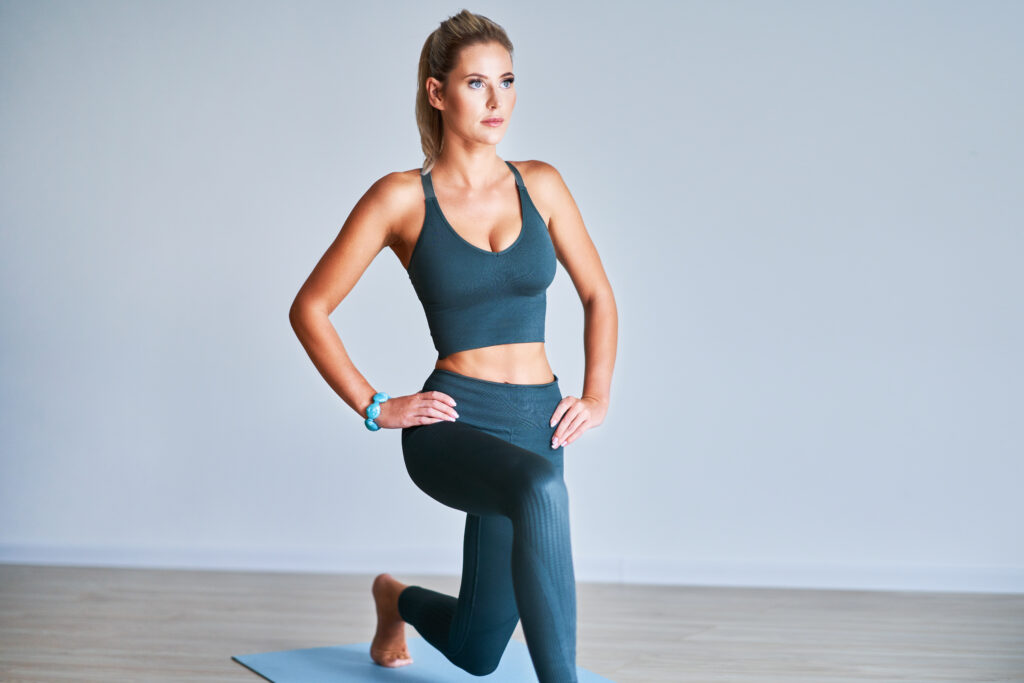
The Routine Quiet-Luxury Women Are Committing To
After speaking to trainers, physiotherapists, and studio founders, the low impact fitness routine most busy women actually stick to looks something like this:
1. Pilates (2–3x per week) – Reformer, mat, or online. Strengthens the core, lengthens muscles, supports posture, and balances the body for longevity.
2. Low-Impact Strength (1–2x per week) – Resistance bands, light weights, or bodyweight circuits to maintain lean muscle mass and metabolic health without overtraining.
3. Mobility & Stretching (Daily, 5–10 minutes) – Quick, floor-based work that improves range of motion, reduces injury risk, and pairs well with sedentary jobs.
4. Walking (As available) – The most underrated longevity tool. Gentle on joints, excellent for stress and heart health, and endlessly flexible.
This combination is sustainable because it isn’t dependent on equipment, studios, or 90-minute sessions. It can be done in 20 minutes between Zoom calls, in hotel rooms when travelling, or quietly before the household wakes up.
Longevity Is the New Peak Performance
The quiet-luxury lifestyle places high value on longevity—glowing skin over contouring, well-tailored coats over micro-trends, and now, training that sustains the body rather than punishes it. It mirrors the wealth shift we’ve been documenting at CSC: status signalling has moved away from spectacle and towards protection—of time, of health, of energy, of the nervous system.
Wealthy women aren’t trying to sprint on a treadmill at 6AM; they’re in Pilates, working on mobility to stay active at 60, not shredded at 30. It’s graceful ageing rather than performance ageing.
The Best Low Impact Fitness Platforms
A few leaders commanding the current space:
- Solidcore – intense Pilates-inspired strength training
- The Ness – low-impact sculpting and dance conditioning
- Fluidform – the Australian method favoured for sculpting and mobility
- Alo Moves – on-demand Pilates, barre, and mobility at home
- P.volve – functional strength for low-impact conditioning
- Classical Pilates studios in London, NYC, and Sydney are resurging
This list isn’t about trends it’s about precision and technique, which is ultimately what makes these workouts effective without being aggressive.
How to Actually Build the Habit
The biggest secret to adherence is friction reduction. Three rules emerged consistently among women who stuck to low-impact training for at least six months:
Shorter is better than heroic. Twenty minutes daily produces better results than two hours once a week.
Location flexibility matters. If you can train at home, at a studio, or while traveling, you won’t fall off the routine.
Aesthetic motivation helps. Clothes, studios, and accessories that feel elegant are behaviourally reinforcing. The CSC woman likes beautiful environments and beautiful equipment because they signal care rather than chaos.
The Quiet-Luxury Feminine Energy of Low Impact Fitness
There is a cultural reason this category is thriving. Low-impact training is not about punishment, fat-burning anxiety, or red-face HIIT maximalism. It embodies feminine strength, restraint, subtlety, and control—qualities long undervalued in traditional fitness discourse.
This is why the quiet-luxury woman gravitates toward Pilates and mobility the same way she gravitates towards Westman Atelier makeup: it enhances what is already there instead of masking it.
The CSC Perspective
If fashion has moved beyond logos into refined tailoring and timeless silhouettes, wellness is intersecting with longevity, nervous system regulation, and elegant discipline. Low-impact training is not a trend; it is a recalibration of priorities.
Busy women do not need more chaos; they need systems that sustain them. And the best routines are the ones they actually stick to.
Want more articles like this? Sign up to the Chic Style Collective newsletter for exclusive editor’s picks, capsule wardrobe guides, and seasonal style tips straight to your inbox.

![The Rich Girl Workout Plan [Adobe]](https://www.chicstylecollective.com/wp-content/uploads/2025/09/Chic-Style-Collective-Hero-Image-701-365x274.jpg "Chic Style Collective | The Rich Girl Workout Plan: Elegant Fitness Routines That Don’t Involve a Sweatbox Gym")
![Elite Sports Only Rich People Play [Canva]](https://www.chicstylecollective.com/wp-content/uploads/2025/09/Chic-Style-Collective-Hero-Image-571-365x274.jpg "Chic Style Collective | The Sports Only Old Money Families Still Play")
![Reformation Pilates[Canva]](https://www.chicstylecollective.com/wp-content/uploads/2025/04/CSC-Featured-image-1017-365x274.jpg "Chic Style Collective | I Tried The Reformer Pilates 30 Day Challenge - Here's What Happened")
